- Published on
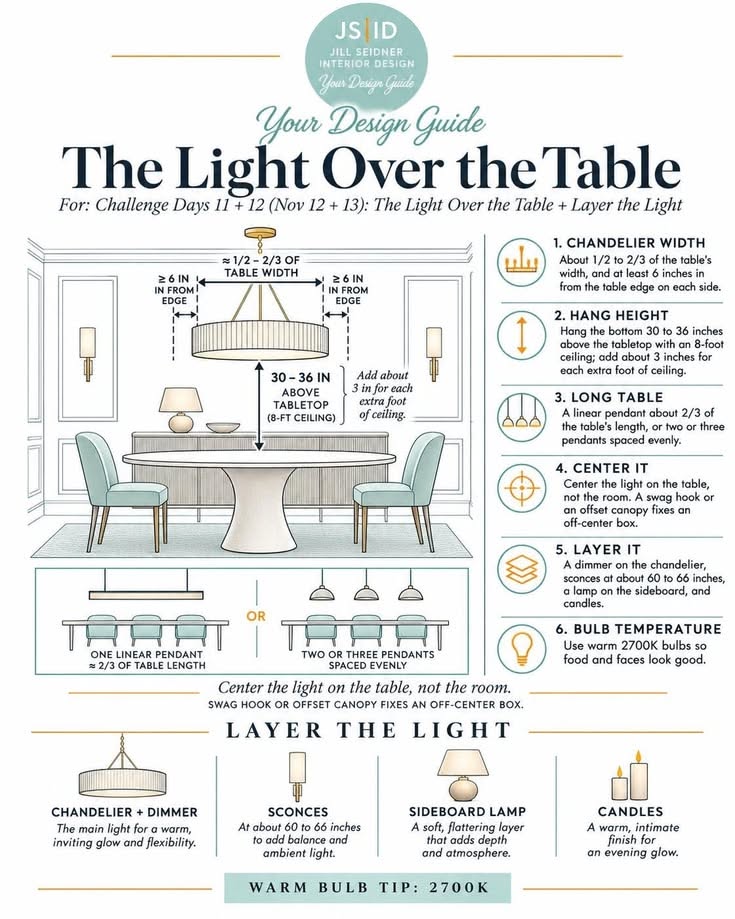
Image above: lighting guide by Jill Seidner Interior Design on Pinterest
A dining room chandelier that is too small reads as an afterthought, and one hung too high makes the whole table feel disconnected. A few measurements give you a useful starting point, then the fixture shape and your sightlines help refine it. This guide walks through the same rules I use in my own Light Over the Table guide: how wide the fixture should be, how low it should hang, what to do with a long table, and the bulbs and dimmer that make the light flattering once it is up.
How big should a dining room chandelier be?
Start from the table, not the room. The fixture should measure about one-half to two-thirds of the table's width, and it should sit at least 6 inches in from the table edge on each side. That margin matters in daily life: anyone rising from a chair or leaning across to serve clears the fixture without ducking.
For a 42-inch-wide table, that means a chandelier roughly 21 to 28 inches across. A 48-inch table takes a 24 to 32 inch fixture. When in doubt between two sizes, the larger one almost always looks more intentional, as long as the edge clearance holds.
If you are lighting a dining area before the table is chosen, use the room rule instead: add the room's length and width in feet, and that sum in inches is a good chandelier diameter. A 12 by 14 foot dining room calls for about a 26-inch fixture.

A tall, tiered chandelier echoes the ceiling details in this formal dining room. Use your own table measurements rather than judging scale from a photo. Image via Jill Seidner Interior Design on Pinterest (originally from Dconcept). View the pin
How high to hang a dining room chandelier
With a standard 8-foot ceiling, hang the bottom of the fixture 30 to 36 inches above the tabletop. For every extra foot of ceiling, add about 3 inches. A 9-foot ceiling lands at 33 to 39 inches; a 10-foot ceiling at 36 to 42 inches.
That range keeps the light low enough to feel connected to the table and high enough that everyone seated can see each other across it. If the fixture has a solid or dark shade, stay toward the higher end, because a heavy shade reads lower than an open or glass one.
Center the chandelier over the table, not over the room. Dining rooms are rarely symmetrical, and the junction box is often not where the table wants to be. An electrician can advise whether a fixture-rated swag hook, a suitable offset canopy or moving the electrical box is the right fix. Follow the fixture maker's support and installation instructions.

A cluster of frosted globes hangs low enough to feel anchored to the table, against a textured white brick wall. Image via Jill Seidner Interior Design on Pinterest (originally from Architectural Digest). View the pin
Chandeliers for long tables and round tables
A long rectangular table needs a fixture that follows its shape. Choose a linear chandelier about two-thirds of the table's length, or hang two or three matching pendants spaced evenly down the table. A small round chandelier can look disconnected from a very long table.
Over a round table, a single centered fixture works best: a round chandelier, a cluster, or a multi-arm design that spreads light evenly to every seat.

A multi-arm fixture over a round table sends light to every seat and keeps the center of the table clear. Image via Jill Seidner Interior Design on Pinterest (originally from DelightFULL). View the pin
Casual rooms: pendants and woven shades
In a casual dining space, a large woven or rattan pendant does the same job as a chandelier with a more relaxed feel. The sizing rules do not change; only the material does. One caution with a very high or vaulted ceiling: resist the urge to raise the fixture all the way up. Keep following the 3-inches-per-foot rule from the tabletop, so the pendant still belongs to the table instead of floating near the ceiling.

A woven bell pendant warms up a vaulted ceiling, hung low enough to stay connected to the table. Image via Jill Seidner Interior Design on Pinterest (originally from MyDomaine). View the pin
Statement fixtures in dark rooms
A dark dining room is the one place a chandelier can go full sculpture. Brass and mixed-metal fixtures glow against deep wall colors, and a fixture with exposed bulbs or open framework keeps the moodiness from turning heavy. Repeat the metal finish somewhere else in the room, in a mirror frame or the flatware, so the fixture feels placed rather than dropped in.

Against navy walls, a brass multi-tier chandelier stands out over the pale table. Image via Jill Seidner Interior Design on Pinterest (originally published by Erika Gosse). View the pin
Bulbs, dimmers and the rest of the light
The chandelier should not be the room's only light. Try these layers: the chandelier on a dimmer, sconces at about 60 to 66 inches or a lamp on the sideboard, and candles on the table when people gather. Layers are what make a dining room glow instead of glare.
For bulbs, use warm 2700K light so food and faces look good. A dimmer helps the same table shift from tasks to dinner. Choose dimmable bulbs and check that the fixture, bulbs and dimmer are compatible.
Shop my picks
This section contains affiliate links. I may earn a commission if you purchase through them, at no additional cost to you. Check current dimensions, finishes and return terms before ordering.
- McGee & Co. Hastings Pendant, over a small dining table, in the same finish family as a semi flush for the adjoining space.
- Joss & Main Flaire 3-Light Semi Flush Mount, the budget fix for a low-ceiling dining nook where a hanging fixture will not fit.
- Lighting I Actually Use, my full lighting collection, with lamps and sconces to layer around a dining chandelier.
If you would rather have the whole room planned for you, my Complete Room Design for $397 gives you two layout options, furniture and lighting picks, paint colors and a linked shopping list, all sized to your actual room. You can also see every service on my online design page.
Getting the table size right comes first, so pair this with my dining table size guide. And if the adjoining kitchen island needs pendants, the spacing rules in my kitchen island ideas post follow the same math.
Dining room chandelier FAQ
How big should a chandelier be over a 60-inch round table?
For a 60-inch-wide table, look for a fixture 30 to 40 inches across. Keep it at least 6 inches in from each table edge, and treat these proportions as a starting point rather than a substitute for the fixture maker's guidance.
Can a chandelier be wider than the dining table?
For a typical dining setup, keep the fixture narrower than the table, with at least 6 inches between its outer edge and each table edge. Check seated sightlines and standing clearance before installation.
How high should a chandelier hang with a 10-foot ceiling?
Hang the bottom of the fixture 36 to 42 inches above the tabletop. That is the standard 30 to 36 inch range for an 8-foot ceiling, plus about 3 inches for each extra foot of ceiling height.
Do I need a dimmer on a dining room chandelier?
A compatible dimmer is a useful choice for switching between tasks and dinner. Pair it with warm 2700K dimmable LED bulbs for the most flattering light.