As an Amazon Associate I earn from qualifying purchases. Some links in this post are affiliate links, at no extra cost to you.
Why a Home Staging Checklist Matters
Buyers decide with their eyes first, online and then in person. In the National Association of Realtors' Profile of Home Staging, 83% of buyers' agents said staging a home made it easier for a buyer to visualize the property as a future home. That's the whole goal: help someone see themselves living there.
It doesn't have to be expensive, either. NAR's 2025 report puts the median spend at $1,500 when sellers used a staging service, and $500 when the sellers' agent staged the home personally. A lot of what follows you can do yourself over a weekend or two.
Start With Repairs, Then Declutter Before Selling
Before you buy a single pillow, fix what buyers will notice: dripping faucets, sticking doors, burned-out bulbs, scuffed trim and cracked switch plates. I've written a whole post on the repairs you should make before selling your home, and it's worth reading first, because staging can't hide a leak.
If your home was built before 1978, pay attention to peeling or chipping paint. The EPA notes that lead-based paint is still present in millions of homes and that deteriorating lead paint is a hazard that needs prompt attention, and sellers have disclosure duties. Talk to your agent before you sand or scrape anything.
Then declutter before selling, and be more ruthless than feels comfortable:
- Clear 70 to 80% of what's on counters, shelves and side tables.
- Pack away family photos, collections, kids' art and anything very personal.
- Edit closets so they look roomy; buyers open every door.
- Take out extra furniture so every room has a clear path through it.
Use Neutral Paint for Selling
Fresh, light paint is the single best value on any staging list. A bold accent wall that you love can read as a project to a buyer. I steer sellers toward warm whites and soft greiges that look clean in photos and work with any furniture. Benjamin Moore lists Revere Pewter HC-172 and Edgecomb Gray HC-173 among its trending neutral colors, and White Dove OC-17, Simply White OC-117 and Pale Oak OC-20 among its popular whites. Always test a sample on two walls first, because the same color shifts a lot with your light.
Stage the Living Room First
If you only stage one room, make it this one. In NAR's 2025 report, buyers' agents said staging the living room was most important for buyers (37%), followed by the primary bedroom (34%) and the kitchen (23%). The living room was also the most commonly staged room (91%).
- Pull the sofa off the walls if the room allows and float it around a rug.
- Keep one clear focal point: a fireplace, a view or one good piece of art.
- Swap busy pillows for two or three calm ones, like these ivory linen-blend pillow covers.
- Hide cords and clear the coffee table down to a tray, a few books and something green.
This light, edited living room is exactly the feeling to aim for:
Image via Jill Seidner Interior Design on Pinterest (originally from Elements of Style). View the pin
The Primary Bedroom: Calm and Hotel-Fresh
Buyers want the primary bedroom to feel like a retreat. Make the bed the star with crisp white or soft neutral bedding, two matching lamps and nightstands cleared of everything but a lamp and a book. Remove exercise equipment, desks and laundry baskets so the room reads as rest, not storage.
Image via Jill Seidner Interior Design on Pinterest (originally from Dwell). View the pin
Kitchen, Bathrooms and Entry
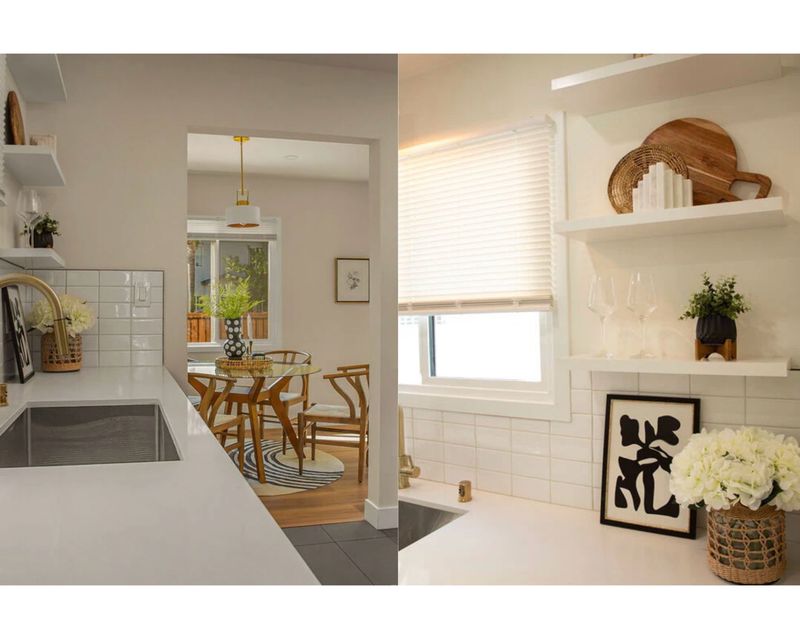
Kitchen: clear the counters except for one or two pretty pieces, like a cutting board and a bowl of lemons. Clean the grout, polish the hardware and take everything off the fridge door.
Bathrooms: put away every personal product. Add a fresh set of white bath towels folded neatly, a new bath mat and one small plant. White towels say "clean" instantly.
Entry: this is the first impression in person. Keep the walkway clear, add a mirror or art at the right scale, and make sure the light works at night. For more ideas, see my post on the best tips for home staging.
Lighting and Final Staging Tips to Sell
Dark rooms feel small in photos. Replace every dead or mismatched bulb with the same warm color so rooms glow evenly. I like soft white LEDs such as these GE Relax HD A19 bulbs. Open every blind for photos and showings and turn on every lamp.
A few final staging tips to sell: set the thermostat to a comfortable temperature, take pets and their bowls out of sight for showings, and do one last walk-through as if you were a buyer. Here's another neutral, layered room for inspiration:
Image via Jill Seidner Interior Design on Pinterest (originally from Meg Lonergan Interiors). View the pin
Your Home Staging Checklist, Room by Room
- Whole house: repairs done, decluttered, neutral paint, matching warm bulbs, clean windows.
- Living room: clear focal point, furniture floated, simple pillows, cords hidden.
- Primary bedroom: fresh bedding, matching lamps, clear nightstands.
- Kitchen: bare counters, clean grout, nothing on the fridge.
- Bathrooms: white towels, personal items away, new bath mat.
- Entry: clear walkway, mirror or art, working light.
Before you list, it also helps to know what buyers and inspectors look for. My post on 3 things to look out for when selling your home covers the rest.
Home Staging Checklist FAQ
Which rooms should I stage first?
The living room, then the primary bedroom, then the kitchen. In NAR's 2025 Profile of Home Staging, buyers' agents ranked those three as the most important rooms to stage for buyers.
Do I need to hire a professional stager?
Not always. Many sellers can declutter, paint and restyle with what they own. NAR's report found a median spend of $1,500 with a staging service versus $500 when the agent staged the home, so ask your agent what they offer.
What paint color is best for selling a house?
Light, warm neutrals: soft whites and greiges that look clean in photos and suit any buyer's furniture. Test samples in your own light before you commit.